When sailors talk about "a force 5" or "a force 8 blowing in", they're using the Beaufort scale – the classic way of describing wind strength at sea. Developed in 1805 by Royal Navy officer Sir Francis Beaufort, it turns an invisible force into a simple number from 0 to 12, based on what you can actually see on the water. Here's what each force means and which winds make for the best sailing.
What is the Beaufort scale?
The Beaufort scale rates wind on a 13-step scale (force 0 to force 12) by its observable effect on the sea – the size of waves, the amount of foam and spray. Its genius is that it needs no instruments: an experienced eye can read the wind straight from the water. Each number also corresponds to a wind-speed range, usually given in knots (nautical miles per hour).
The Beaufort scale at a glance
| Force | Knots | Description | Sea state |
|---|---|---|---|
| 0 | <1 | Calm | Mirror-flat |
| 1 | 1–3 | Light air | Ripples |
| 2 | 4–6 | Light breeze | Small wavelets |
| 3 | 7–10 | Gentle breeze | Large wavelets, first crests |
| 4 | 11–16 | Moderate breeze | Small waves, some whitecaps |
| 5 | 17–21 | Fresh breeze | Moderate waves, many whitecaps |
| 6 | 22–27 | Strong breeze | Large waves, spray |
| 7 | 28–33 | Near gale | Sea heaps up, foam streaks |
| 8 | 34–40 | Gale | Moderately high waves |
| 9 | 41–47 | Strong gale | High waves, dense foam |
| 10 | 48–55 | Storm | Very high waves |
| 11 | 56–63 | Violent storm | Exceptionally high waves |
| 12 | 64+ | Hurricane | Sea white with spray |
Which wind is best for sailing?
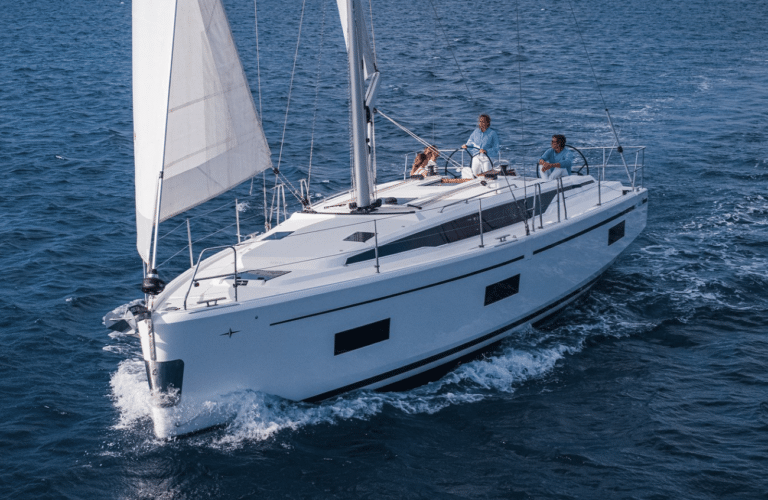
For a relaxed, enjoyable sail, force 3 to 4 (roughly 7–16 knots) is the sweet spot: enough wind to move nicely under sail, gentle enough for comfort and easy swim stops. Force 5 is exhilarating – the boat heels and picks up speed, and it's a favourite of keen sailors. From force 6 upwards the sea gets lively and you'll reef the sails; force 7 and above is demanding weather that calls for experience. Below force 2 there's often too little wind to sail at all, and the engine comes on.
This is exactly where a professional skipper earns their keep: reading the forecast, choosing sheltered routes and knowing when to reef. On a shared trip you get all of that built in – see our sailing trips.
Mediterranean winds and the Beaufort scale
Popular sailing areas have their own famous winds. The Meltemi of the Greek Aegean and Cyclades can blow force 6–8 in high summer; the Mistral of southern France and Sardinia arrives suddenly from the northwest; the Adriatic's Bora is a cold, gusty force to respect. Knowing what each force feels like helps you understand a forecast – our sailing wiki has more on reading weather at sea.
Frequently asked questions
What wind force is good for beginners?
Force 3 to 4 (about 7–16 knots) is ideal for beginners – enough wind to sail properly, calm enough to stay comfortable.
How many levels does the Beaufort scale have?
Thirteen: force 0 (calm) through force 12 (hurricane), each tied to a wind-speed range and a described sea state.
At what force do you reef the sails?
Typically from around force 5–6, depending on the boat and crew. Reefing reduces sail area to keep the yacht balanced and safe as the wind builds.
Conclusion
The Beaufort scale turns wind into a language every sailor shares – from a mirror-calm force 0 to a screaming force 12. For most of us, force 3 to 5 is where the magic happens. Want to feel it for yourself? Book a skipper training week and learn to read the wind first-hand.