Packing list
The packing list for your sailing adventure - Sailing with sailwithus
Pack Your Bags & Set Sail
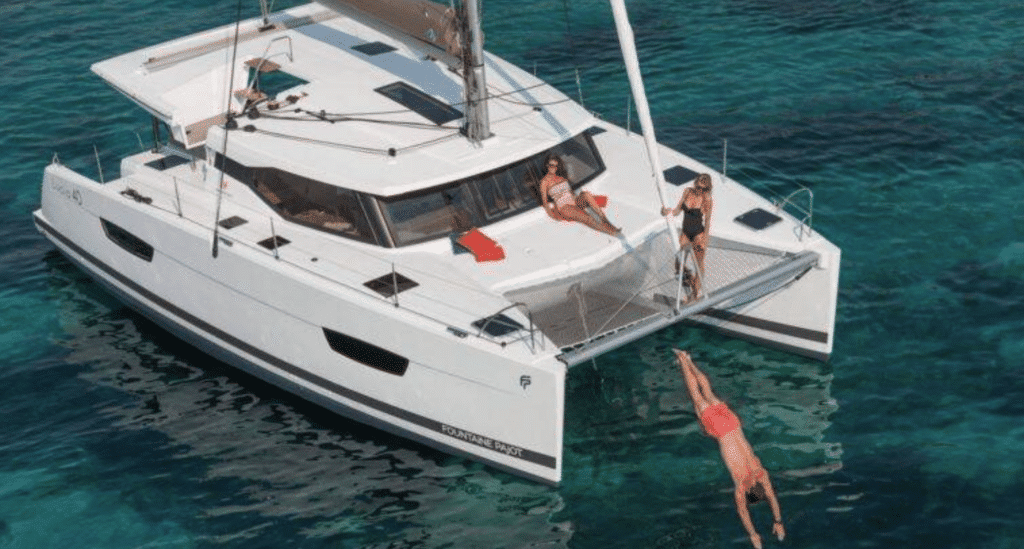
Joining a trip with sailwithus is effortless. No experience needed! Your berth and life jacket on a modern yacht are already reserved. To help you pack light and smart, we've put together tailored packing lists for every adventure, whether you're embarking on a 7-day trip, setting sail in the fall, or planning a family holiday. (Heading out in the off-season? Be sure to pack a few extra layers for chilly evenings!)
Travel Sustainably: Please leave disposable items, ike single-use air mattresses, at home. Instead, you can rent durable gear like stand-up paddleboards and BBQs directly from us.
You can also prep for your trip using our Sailing Wiki, where we break down common nautical terms.
Download your packing list below:
Packing list - why do you need the following items?
-
A- Cat
-
A construction class of single-handed catamarans. They are the fastest single-handed catamarans in the world. They are mainly used for sport sailing, and world and European championships are sailed annually with impressively large fields of 80 to 100 boats. An A-Cat may be a maximum of 18 feet (5.49 m) long and 2.30 m wide. The sail area is also limited to 150 square feet (13.94 m²) and the weight is limited to 75 kg.
-
Achterholer
-
A line or rope used to tighten or control the aft part of the sail.
-
Aft
-
Nautical term for "aft". This is also often used in connection with other words such as stern, which means the aft section of the ship.
-
Aft deck
-

the deck above the stern, i.e. the aft deck.
-
Aft out
-
Sailboat moves with the stern in the direction of the wind or the source of power.
-
Aft spring
-
A rope that is attached aft to stabilize the ship when mooring.
-
Anchor
-

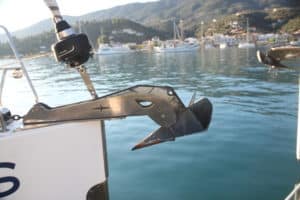
Hook-shaped metal part that usually hangs from the front of a sailing yacht and is lowered to the bottom to hold a ship or yacht in position. The anchor digs into the sand on the bottom and thus holds the ship in position. A weighted anchor works differently, holding the ship in position by its weight alone.
Drop anchor in the most beautiful bays on one of our adventure cruises in Croatia.
-
Anchor ball
-
An anchor ball is a round signal that indicates that a ship is at anchor. In maritime shipping, the anchor ball is often used to signal to other ships that the ship is anchored in this area and may not be maneuverable.
-
Anchor chain
-
A chain, usually made of metal, on which the anchor is lowered.
-
Beacon
-
A marking of harbor entrances or for orientation. Originally, light signals were found on land (as small lighthouses), later also with lightships or light buoys on the water.
-
Beaufort scale – wind force (BFT)
-
A scale for wind speed and wind force that was developed in 1806 by the English admiral Sir Francis Beaufort. At that time, wind speeds could not yet be measured and were determined by observing the sea and the waves.
It is said that his ship had 12 sails and depending on the strength of the wind, he could tell how many sails should be set. Nowadays, the scale is based on observations of the sea surface and represents wind forces from 0 to 12.- 0 Bft (0-<1kn) - calm, calm - mirror-smooth sea
- 1 Bft (1-<4kn) - light draught - slight ripples
- 2 Bft (4-<7kn) - light breeze - small, short waves, glassy surface
- 3 Bft (7-<11kt) - light breeze - beginnings of foam formation
- 4 Bft (11-<16kn) - moderate breeze - small, lengthening waves, foam heads everywhere
- 5 Bft (16-<22kn) - fresh breeze - moderate waves of great length, foam heads everywhere
- 6 Bft (22-<28kn) - strong wind - larger waves with breaking heads, white foam patches everywhere
- 7 Bft (28-<34kn) - stiff wind - white foam from the breaking wave heads lies in foam strips in the wind direction
- 8 Bft (34-<41kn) - stormy wind - quite high wave crests, their heads are blown away, foam streaks everywhere
- 9 Bft (41-<48kn) - storm - high waves with blowing spray, breakers begin to form
- 10 Bft (48-<56kn) - heavy storm - very high waves, white spots on the water, long, breaking crests, heavy breakers
- 11 Bft (56-<64kn) - hurricane-like storm - roaring sea, water is blown away horizontally, severe reduction in visibility
- 12 Bft (>64kn) - hurricane Sea completely white, air filled with foam and spray, no more visibility
-
Before the wind
-
Upwind or downwind means that a boat sails with the wind. The wind comes from behind.
-
Bilge pump
-
A device on a ship or boat that is used to remove water (also known as bilge water) from the hull. It can be operated manually or electrically and is an essential safety element to keep the boat afloat and prevent it from sinking.
-
Boat license
-
Before acquiring a boating license, the first step is to precisely define your own needs in order to decide which boating license is necessary and which combinations make sense.
- Do I only want to sail or am I also interested in steering a motorboat?
- Do I stay on a lake or am I drawn to the sea?
- Is everything conceivable?
Of course, you can start small and build up. However, you should consider choosing the more diverse patent, which offers more possibilities. The tests are also associated with costs and a precise consideration of the combinations is helpful for pricing.Below you will find an overview of all common boating licenses, the requirements for obtaining them and their areas of validity.
These official recreational boating licenses are valid internationally and can therefore be used in our cruising areas. Enjoy secluded islands and bays in Croatia, discover Greece, get to know quaint harbor towns in Sardinia, explore the Côte d'Azur in France, benefit from Turkish hospitality or snorkel around coral reefs in the turquoise blue sea in Thailand.
To complete your training, it is advantageous to obtain radiotelephony certificates. You will also find a brief overview of this after the descriptions of the boating licenses.
Make the right decision and get started with the right boat license for you.Pleasure craft license inland (SBF Binnen)
Authorization and scope of action:
This license entitles the holder to steer a pleasure craft under 20 meters in length (Rhine: less than 15 meters) on federal waterways. Recreational craft with an engine power of less than 15 hp (Rhine: 5 hp) are exempt from the requirement for a license, as are craft propelled by muscle power or a sail with an area of less than 6 m².
Prerequisite for the purchase:
- 14 years (sail), 16 years (motor)
- Medical certificate (sight/hearing test/physical and mental fitness)
- Driver's license or certificate of good conduct "O"
- For minors: Declaration of consent from the legal guardian(s)Type of tests:
- Theory: navigation law, meteorology, seamanship, special questions on inland navigation, specific questions on sailing (only for sails)
- Practice: knot tying and maneuvers.
The theory and practice examinations do not necessarily have to be taken at the same location.
If you hold the SBF See, the practical examination for the engine propulsion type is waived, as is part of the questionnaire. Holders of the Sportküstenschifferschein or the Sporteeschifferschein do not require a practical examination in the sailing propulsion mode. Lake Constance boatmaster's certificates A and D can be transferred without an additional examination.Pleasure craft license sea (SBF See)
Authorization and scope of action:
This license entitles the holder to steer motorized boats with a power of more than 15 hp (no restriction on hull length) for sport and leisure purposes on maritime waterways (three nautical mile zone and fairways of the twelve nautical mile zone).
Possession of this license permits the operation of pleasure craft on maritime waterways in tidal areas. This license is only valid for motorized boats; it is not required to operate a sailing boat without a motor. The inland pleasure craft license is not required and is not included in this license.Requirements for the purchase
- 16 years
- Medical certificate (sight/hearing test/general state of health)
- Driver's license or certificate of good conduct "O"
- For minors: Declaration of consent from the legal guardian(s)Type of tests:
- Theory (divided into question and chart sections): Navigation, accident prevention rules, maritime regulations, collision prevention rules, meteorology, seamanship, vessel handling and environmental protection
- Practice (does not necessarily have to be completed on a shipping lane): Knot tying and maneuvers
The Sport Boat Driving License Inland (SBF Binnen) can be partially credited, seven basic questions are omitted.Pleasure craft license (SKS):
Authorization and scope of action:
This certificate entitles the holder to steer yachts with motor propulsion as well as under sail in coastal waters, i.e. all seas up to 12 nautical miles from the mainland coast and also entitles the holder to undertake commercial trips in coastal waters (observe crew regulations). Can also be obtained alone in the motorized version.
Can be used abroad as a qualification to demonstrate the ability to operate pleasure craft.Requirements for the purchase:
- 16 years
- Possession of a recreational boating license
- Proof of 300 nautical miles on a yacht in coastal waters.Type of tests:
- Theory (question and chart part): Navigation, shipping law, seamanship, complex charting, meteorology, complex charting task
- Practice: man overboard maneuvers with motor and sail, knot tying, condition of the ship
This certificate can also be issued for the motor variant only, in which case the sail-specific questions are omitted and the examination takes place on a motorboat.Get your SKS license with us on one of our SKS training cruises in Croatia or Mallorca.
Sport sailing license (SSS)
Authorization and scope of action:
This license entitles the holder to steer boats/yachts with motor propulsion or in sailing mode in coastal waters (all seas within 30 miles of the coast as well as the entire Baltic and North Sea, the English and Bristol Channel, the Irish and Scottish Seas, the Mediterranean and the Black Sea).
If pleasure craft are used commercially, this boat license is absolutely necessary (observe crew regulations).Requirements for the purchase:
- Possession of a recreational boating license at sea
- Alternatively:
- 1,000 nautical miles on yachts of the corresponding propulsion type
or
- At least 700 nautical miles of the selected propulsion type after acquiring the recreational coaster license (proof only at the practical examination).
or
- At least 700 nautical miles on boats in the sea area after acquiring a BR license before 1.10.1999Type of tests:
The overall examination must be taken within 36 months and the theory examination must be passed within 24 months, otherwise any parts already passed will be forfeited. A failed partial examination can be repeated after two months at the earliest.
- Theory: shipping law, radar plotting, navigation (map task), seamanship, meteorology
- Practice: is carried out on a seaworthy yacht.
This certificate can also only be completed for motorized boats.Sport offshore license (SHS)
Authorization and scope of action:
This certificate entitles the holder to steer yachts as well as training and traditional vessels with a motor and/or under sail on all seas, i.e. worldwide. It is mandatory for worldwide commercial use (observe crew regulations).
The pleasure craft license is valid worldwide with the restriction of a maximum crew of 12 persons (yacht) and traditional vessels up to 25 meters in length with more than 12 persons on board.Requirements for the purchase:
- 18 years
- Sportseeschifferschein
- 1,000 nautical miles on boats in sea use and acquisition of the sportseeschifferschein as skipper*in, co-skipper*in or watch leader*in
- taking the exam possible from 500 nautical miles, issued after proof of missing milesType of tests:
- Theory:
- written: navigation (incl. astronomical navigation), shipping law (incl. maritime law), meteorology (incl. tropical cyclones)
- oral: use of yachts, nautical and technical aspects relating to yacht steering, sailing in heavy weather, behavior in areas with cyclones.
- practical: use of the sextant, checking and explanation of three common errors, vertical angle calculation.The SSS can also be purchased for motor only.
Inland navigation radio operator's certificate (UBI)
It entitles the holder to operate a VHF radio station on inland waterways, is valid internationally and for an unlimited period.
Examination possible from 15 years of age.Radiotelephone at sea (SRC)
Authorizes the operation of a marine radio service in the worldwide maritime distress and safety system for VHF on pleasure craft and is valid internationally and indefinitely. Since 15.8.05, this radiotelephony certificate has been mandatory for all skippers of a seaworthy yacht in sea area 1.
Radiotelephony combination (UBI + SRC)
Recommended for owners of an SBF (inland and/or sea). Since 15.8.05 this radiotelephony certificate is mandatory for all skippers of a seaworthy yacht in sea area 2.
Radiotelephone at sea (LRC)
Authorizes the unrestricted use of a marine radio service at radiotelephone and marine radio stations as well as marine earth stations and radio facilities of the GMDSS for VHF, HF and GW as well as marine radio via satellites on pleasure craft. Examination possible from the age of 18, international and valid indefinitely.
-
Bowline
-
One of the most important sailing knots. The bowline forms a strong sling that does not tighten under tension. It is often used on a sailing yacht and is used, for example, for mooring to a bollard during mooring maneuvers. Deepen your knowledge on an SKS training cruise in our sailing areas of Croatia or Mallorca.
-
Bunk
-
Berth = bed on a ship, on yachts there are double berths or bunk beds with single berths.
-
Clew
-
The rear, lower corner of a triangular headsail (cf. head and neck).
-
Clicker
-

The clicker is attached to the top of the mast and is usually shaped like an arrow. The clicker indicates the apparent wind, the wind direction.
-
Collision prevention rules
-
38 rules for avoiding collisions at sea. Internationally, rules have been drawn up on the topics of general, navigation and evasion, navigation lights and signal bodies as well as sound signals and light signals. These were adopted by the International Maritime Organization (IMO) in 1972 and 63 countries transposed them into national law.
-
Cordage
-
Nautical term for rope or cordage. Thin ropes are called tapes, thick ropes are called hawsers. Cordage usually consists of natural fibers (hemp, cotton, coconut fibers), synthetic fibers (polyamides (nylon, perlon), polyester, polyethylene) and steel wire. A distinction is also made between twisted and braided cordage.
-
Course
-
When sailing, the course is based on the wind direction: Downwind course (the wind is coming from behind - 180°), downwind course (approx. 100° - 170° from behind), half-wind course (approx. 90°) and upwind course (45°)
Set course with us for a dream vacation on our Youngline sailing vacations in Croatia.
-
Cranes
-
If a ship lays on its side for a short time (for example due to strong wind pressure), it will heel. However, this usually only happens with smaller sailing boats. It almost never happens with the large yachts we sail in the Mediterranean.
-
Cross bearing
-
Certain type of ship location determination. Two objects are sounded at approximately the same time, the bearings of which are entered in the nautical chart as a bearing line to the sounding objects and the location can then be determined from the intersection of the two lines.
-
Cross knot
-
The square knot connects two ends of equal strength. The cordage should be of equal strength and made of the same material. When tying a square knot, make sure that the two ends are on the same side. The square knot is first tied right over left, then left over right (two half knots reversed on top of each other). Tightened correctly, it is difficult to untie. Expand your sailing knowledge on one of our SKS training trips in our sailing areas of Croatia and Mallorca.
-
Crossing
-
Sailing in a zigzag course against the wind. Compared to sailing on a line from A to B, for example, crossing takes a very long time.
-
Cruise
-
A sailing trip
-
Cutter
-
A type of sailboat that has two masts.
-
Dead lull
-
Wind force zero on the Beaufort scale, so no wind at all. So there is not even the slightest breeze for sailing.
-
Dew
-
The term rope is not used on board. The generic term is rope, twine, hawser, line, etc.
-
Displacement travel
-
A speed where the yacht is embedded in its bow wave and stern wave. The maximum speed at displacement speed is called hull speed. A yacht can only sail even faster when planing.
-
Dissuade
-
refloat a ship/yacht that has run aground. This can be done by heeling, lightering or using a towing aid.
-
Distraction
-
Deviation from a planned course or direction due to external influences such as wind, current or waves.
-
Distress at sea
-
An absolute emergency situation on a ship where the lives of the crew are in danger and immediate assistance is required. Mayday" is also used in maritime radio to call for help.
-
Downwind course
-
A course in which the wind comes in from astern and the sails are set wide.
-
Draught
-
The depth to which a boat submerges in water.
-
Drift
-
A drift refers to the sideways movement of a ship and is caused by the wind. Possible drifts must be taken into account in advance during navigation.
-
Drift current
-
Current at sea that is created by wind alone. The strength of the current depends on the strength of the wind. The strongest and most constant drift current is the equatorial current generated by the trade winds.
-
Easing
-
The wind dies down to calm, i.e. until the wind almost dies.
-
Electricity
-
Marine term for current. Currents can occur in different ways: in rivers, in tidal areas (tidal current), as an ocean current (e.g. the Gulf Stream) and as a surface current (triggered by the wind, known as a drift current).
-
Fall off
-
The opposite of luffing: a change of course to the side away from the wind (leeward). This is followed by less pointed sailing.
-
Fog signal
-
A fog signal is an audible signal used in fog to indicate the presence of a ship, danger or navigational aid to other ships, boats or persons. They can take various forms, such as horns, foghorns or chimes, depending on local regulations and conditions.
-
Foot
-
Lower side of a sail.
-
Forebody
-
The front part of the ship
-
Foresail
-
Sail in front of the mast.
-
Foresheet
-
Line - sheet for the headsail.
-
Forestay
-
Part of the standing rigging (rigging rope) that runs from the foreship to the mast and keeps it from falling over aft. Yachts usually have a double forestay.
-
Fuel
-
A pole that is attached to a sail and determines the shape of the sail.
-
Gliding
-
The hull speed is slightly exceeded without reaching planing speed. On a yacht, the stern dips quite deeply into the wake and the stern wave remains one to two meters behind the stern.
-
Head
-
The upper corner of a triangular sail (compare neck and clew).
-
Headbutt
-
For the head lay, a line is turned so that it clamps itself. The head slap prevents a line from coming loose from a cleat.
-
Hull
-
The entire body of a boat.
-
Hull speed
-
Modern yachts generate hydrodynamic buoyancy so that they can leave the stern wave behind them and planing. This allows them to achieve the highest possible speed in displacement sailing.
Deepen your knowledge on an SKS training cruise in our areas of Croatia or Mallorca.
-
Incorrect course
-
The magnetic heading is the direction of a ship or aircraft relative to the geographic North Pole. It is calculated by adding or subtracting the local declination (the angular difference between the geographic and magnetic north pole) to or from the compass heading.
-
Leader line
-

Mooring line at the bow.
-
Leech
-

The rear side of the sail.
-
Lie
-
The angle between the wind and the sail area.
-
Life raft
-
A floating platform used to rescue yourself on the water in an emergency.
-
Light buoy
-
A light buoy is a buoy equipped with a beacon. It is used in maritime shipping to mark obstacles, fairways or other relevant points in waters. The beacon on the buoy helps ships to navigate, especially at night or in poor visibility conditions.
-
Log
-
Speedometer on ships; a log can also be used to measure the distance sailed.
-
Lower edge
-
The tensioning with ropes of the mast, which thus contribute to the stability and runs underneath the Sailing.
-
Luff
-
Front side of a sail.
-
Luke
-
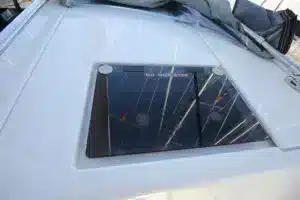
Is often a window on a yacht. A hatch is a lockable cover for ventilating a yacht.
-
MMSI
-
MMSI stands for "Maritime Mobile Service Identity". It is a unique nine-digit number that is assigned to a marine radio or a radio station. This number is used to identify ships, coastal stations and groups of ships for communication purposes and as part of the Automatic Identification System (AIS).
-
MRCC
-
MRCC stands for "Maritime Rescue Coordination Centre". These centers are responsible for coordinating search and rescue (SAR) operations in emergencies at sea. They work around the clock to provide fast and effective assistance in the event of accidents or emergencies in the maritime sector.
-
Man overboard maneuver
-
The maneuver is one of the first and most important things everyone learns. It involves practicing what to do in an emergency if someone falls off the boat. The maneuver is practiced with a buoy that is thrown into the water. In an emergency, the call "Man overboard" is then made and a lifebuoy is thrown to him. A crew member is assigned to keep an eye on him. If the yacht's engine is running, the stern (with the rotating propeller) must first be turned away from the person. Depending on the situation, an attempt is then made to get the person who has fallen overboard back on deck. There are different techniques depending on how high the deck is, where you are and how the person is feeling (is he or she unconscious?).
-
Maritime radio certificate / SRC
-
There are two marine radio certificates, SRC, Short Range Certificate and the General Radio Operating Certificate, LRC, Long Range Certificate. The VHF radio operator's certificate entitles the holder to participate in marine radio.
-
Mast
-

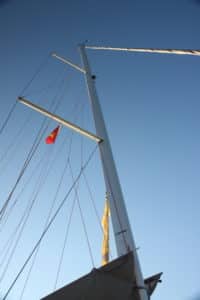
The mast goes from the bottom to the top of a boat and is the most important part of the rigging on a sailing boat. The mainsail, for example, is set on the mast.
-
Masthead
-
The upper part of the mast, which often carries additional equipment such as Windex (wind direction indicator) or lightning rods.
-
Mayday
-
Call for help on marine radio when a vessel (ship, aircraft, ...) or a person is in distress at sea. During a radio call, the radio signal is spoken 3 times.
-
Measurement letter
-
an official document that records the specific dimensions and technical details of a sailboat or yacht. This document is often issued by an authorized organization and contains important information such as the length, beam, draft, weight and sail area of the boat. The measurement certificate is crucial for the classification and categorization of boats in regattas, as it ensures that boats of comparable size and performance compete against each other. It also serves as proof of conformity with the class rules in competitions.
-
Monohull
-
A monohull is a boat or ship with only one hull, as opposed to multihulls such as catamarans or trimarans, which have two or more hulls. Monohulls are the most traditional and widespread form of watercraft. They range from small sailing boats and rowing boats to large sailing yachts and ocean liners.
-
Muring
-
Mooring lines, also known as mooring, are often found in the Mediterranean. This is a mooring line that is attached to a concrete block in the water in the harbor. It keeps the yacht away from the jetty in a harbor. There are also mooring buoys to which you can attach the yacht so that you don't have to drop anchor overnight.
-
Nautical mile
-
A nautical nautical mile has a length of 1,852 m compared to a mile of 1,609.3 m. The nautical mile is calculated from the circumference of the earth. 40000 km are divided by 360° and 60 minutes = 1,852 m.
-
Navigation light
-
A light designed to draw attention to a yacht at night and in reduced visibility.
-
Oberwant
-
Top shroud attached to the mast, which contributes to the stability of the mast with ropes, is spread out by the sails and leads down to the hull.
-
Obligation to stay on course
-
Written down in the KVR: "If one of two vehicles has to take evasive action, the other must maintain its course and speed."
-
Offshore wind
-
When the wind comes from the land and blows towards the water.
-
On the wind
-
A boat sails pointed into the true wind (at an angle of 40° to 45°). The sheets are close-hauled, on a dinghy the centerboard should be fully lowered.
Sail downwind with us on one of our SKS training cruises in Mallorca or Croatia
-
Outhaul
-
Small tackle on the main boom, with the help of which the mainsail foot can be more or less tensioned.
-
Overclocked
-
A yacht or ship is over-rigged if the sail area is too large in relation to the stability of the hull.
-
Overdue
-
when a ship or yacht is underway longer than expected or planned without arriving at a certain point or destination. This can be due to various circumstances such as bad weather, navigation problems or technical difficulties.
-
Overlap
-
A term used in competitive sailing. If no boat is clearly astern, i.e. not a whole ship's length ahead, the boat astern overlaps the boat ahead.
-
Pallen
-
The loosening of a rope or line to reduce the tension of the sail and thus adjust the sail position to changing wind conditions.
-
Passat
-
A year-round, steady wind that blows in the northern hemisphere as the north-east trade wind and in the southern hemisphere as the south-east trade wind. It generates the equatorial currents through its strength and consistency.
-
Ree
-
Reducing the sail area by tying or folding down part of the sail to reduce the sail power in stronger winds and improve the boat's maneuverability.
-
Reefing
-
Reefing reduces the sail area. With a furling system, for example, the sail is furled with a headsail / genoa or the mainsail is brought onto the boom.
Deepen your knowledge on an SKS training cruise in our areas of Croatia or Mallorca.
-
Reversing wind
-
Wind whose direction rotates counterclockwise, often due to weather changes or local geographical conditions.
-
Riding out
-
Hanging outside (outboard) of the sailboat to improve the stability of the boat in strong winds. It can be ridden in a harness or free-floating. In this case, the feet are in a harness and the upper body floats horizontally above the water. This is mainly used for smaller sailing boats and sporty sailing.
-
Rigging
-
The way a yacht's masts and sails are arranged.
-
Rigging
-
The rigging
Rigging, also sometimes referred to as rigging, is the term for all standing rigging on a sailing ship. This also includes parts of the running rigging. Specifically, this can include, for example, the rigging or the masts, but also blocks, fittings and spars. The masts are kept stable by the rigging. The so-called running rigging is necessary for operating the sails, but is not attached directly to the ship. However, the sails and sheets are not part of the rigging, even if the latter are part of the running rigging.
The term "rigging" is derived from the rig, which is a heavy tackle consisting of two multi-disc blocks (tackles are pulleys). Accordingly, one says "the ship has been rigged".
History of rigging: from antiquity to modern times
Rigging has a long history. Its traces can be traced back to prehistoric and ancient times. For thousands of years, it was common practice to use a single mast with an ordinary square sail on sailing ships. Accordingly, the rigging consisted of rather simple elements. During the Roman Empire, the so-called "bowsprit" was invented, which resembles a very strongly inclined foremast. This represented a significant evolution in shipping. Nevertheless, the construction of sailing ships remained rather simple at this time.
During the Middle Ages, on the other hand, bulines were used. These are mooring ropes that are attached to the side edges of the rather bulbous sails, from where they lead to a bowsprit. This is a bowsprit that points out over the bow. This standing rigging was strung with ropes, creating a kind of hanging ladder made of ropes. This made it easier to stay afloat and to sail away.
The modern era, which slowly began in the 15th century, also marked a new phase in the development of rigging. In northern and western Europe, sailing ships gradually began to be designed larger than before. Instead of one, they were now increasingly equipped with two or even three masts. The main mast was located in the middle of the ship. The other masts were installed in the fore and aft castellations. This increased the defense capacity of the ships enormously. A spar was attached high up on the main mast, the marsstenge. An additional sail was attached to this. However, the main mast sail was soon followed by another sail, which was mounted on the foremast. The size of the sails also increased steadily, making the sailing ships ever more imposing. This development came to a temporary end with the well-known lateen sail, which was developed in the Mediterranean region. -
Ropes
-
Short cordage
-
Round aft
-
The maneuver of a jibe is started with the command "round astern".
Jibe sequence:
Command: "Ready to jibe" - the helmsman steers the boat downwind - the mainsheet is brought close, i.e. pulled tighter - then comes the command "round astern" - the wind pushes the sails to the other side - now the mainsheet must be "released" again quickly. -
Round trip
-
A line is placed once (360°) around something.
-
Rudder
-
There is a rudder blade, which is needed to steer a yacht.
-
Rudder system
-
The steering gear of a ship comprises the entire system used to steer the ship. This includes the rudder blade itself, which is controlled by the steering gear, as well as the steering devices operated by the helmsman to move the rudder and thus change the direction of the ship.
-
SBF See (recreational craft license sea)
-
SBF See is the abbreviation for the motorboat license - Sportbootführerschein See, SBF Binnen is the abbreviation for the Sportbootführerschein Binnen.
No SBF-See yet?
Our renowned partner, Bootsschule1, opens the doors to the fascinating world of water sports for you! With a team of experienced instructors, first-class teaching methods and individually tailored course times, Bootsschule1 offers comprehensive training. Best of all, you can conveniently take your exam at one of numerous locations throughout Germany. Put your trust in the expertise of Bootsschule1 and start your personal nautical journey of discovery now. Let yourself be infected by the passion for sailing and obtain your SBF-See quickly and reliably!

-
SRC
-
Short Range Certificate, English term for radio certificate.
-
Sail
-
From the Old High German "segal", which probably originally meant a cut piece of cloth. This is used to propel sailing boats and other vehicles by the wind. Depending on their construction, sails are divided into square sails and square sails. In the past, sailcloth was made from vegetable fabrics, later also from woven synthetic fibers and today laminate sails based on plastic films are also used.
-
Sail area
-
The area of a sail.
-
Sail repair
-
The repair of sails.
-
Sail trim
-
Refers to the adjustment of the sails and the process of adjustment.
-
Sailboat
-
A boat that is propelled by sails.
-
Sailing area
-
A specific area or body of water in which sailing takes place.
-
Sailing direction finding
-
The location of an object can be determined by taking two bearings. A distinction can be made between cross and double bearings.
-
Sailing maneuvers
-
The most important sailing maneuvers
Nowadays, yachts are often equipped with an engine, which is usually more powerful than a conventional auxiliary unit. The engine makes some maneuvers such as anchoring or mooring and casting off much easier. It used to be fashionable to maneuver into the marina without the help of the engine. Today, it is undesirable to moor in the harbor under sail and is usually prohibited by the harbor regulations alone. Many standard maneuvers should be mastered by the skipper, but also by the other crew members. All important information can be found under Contact request - Sailing on vacation | sailwithus (pixelriver.de).
Turnaround
In this sailing maneuver, the bow of the yacht is turned by the wind. This means that it briefly sails against the wind direction. After the turn, it should be possible to sail a course with the wind coming from the other side. Before the start of the maneuver, the yacht sails a so-called upwind course, with the wind coming diagonally from the front. The yacht is then steered so that the bow is turned by the wind. The sails change from the side facing away from the wind to the side facing away from the wind. The commands for this maneuver are: helmsman: "Clear to tack", crew: "Is clear", helmsman: "Ree - over the jib." Depending on the type, the yacht loses considerable speed during this maneuver because there is no propulsion from the sails. The rudder effect can diminish so much that the bow cannot be pushed by the wind. In such a case, it is advisable to keep the jib "back" for a while. Then the jib is not yet pulled to the other side. Then it falls in, pushes into the shrouds and pushes the bow into the new course. The fog is only brought to the other side when the new course is almost reached.
Jibe
In this sailing maneuver, the stern of the yacht is turned by the wind. The yacht therefore sails briefly in the direction of the wind. The aim is to sail a new course with the wind coming from a different direction. When the maneuver is initiated, the yacht is sailing on a beam reach course with the wind coming from behind (aft). The sails are furled wide and are perpendicular to the midship line. The yacht's course is altered so that the sails are folded from one side to the other and the wind then comes from astern. In order to minimize the large force that is generated when the sails are folded, the mainsail is hoisted tightly. This means that not so much momentum is taken from the sail before it falls into the sheet. At the moment the sail goes over, the sheet is also feathered to further reduce the acting forces. If the main boom rolls over uncontrollably, considerable forces are generated which can lead to capsizing. In a yacht, this leads to high wear and tear on the material and, in the worst case, to damage to the rig. The commands for this maneuver are: helmsman: "Ready to jibe", crew: "It's clear", the mainsail is hoisted tight. Helmsman: "Round astern." The wind pushes behind the mainsail and flips it over. At this point, the sail must be unfurled quickly and counter rudder applied to stabilize the yacht. The crew switches to the other side and the headsail is also hoisted to the other side.
Q-turnaround
This maneuver is a turn that is made instead of a tack. The yacht is sailing on a downwind course with wind from starboard and wants to change to a downwind course with wind from port. This tack is the most effective way of changing course. An angle of 90° is described. The yacht steers to starboard and windward until it is sailing downwind. Then a classic tack is made until the yacht sails downwind again, which then comes from port. Then, instead of an angle of 90°, an angle of 270° is described. Although this maneuver takes quite a long time, it also gives you a great sense of security.
Turning and shimming
Turning and leaning over is a state in which the yacht lies comparatively calmly with the lowest speed and a little drift. To achieve this state, the yacht makes a turn, leaves the foresail back, steers against it and holds the rudder in this position. The mainsail is fully unfurled. This creates dead water to leeward, which can be used to recover people.
Man overboard
This maneuver is used to pick up a crew member who has had an accident. It is the most difficult standard maneuver, but extremely important. It should always be mastered by several crew members, not just the skipper. The maneuver can simply be practiced with an old lifejacket or a fender. However, it is important to remember that a lifejacket or fender is lighter than a person. In addition, a fender cannot freeze in the water. The emergency situation is therefore different from the training situation. In an emergency, every move has to be right, as there is very little time available for the rescue. Depending on the situation, there are two variants to choose from for the maneuver.
In stronger winds, a maneuver with a Q-tack is used, as the yacht moves away from the casualty very quickly and is difficult to get back with a tack. However, this maneuver requires a lot of time and space. The yacht turns so far that the previous course is crossed, drops off and performs a close-hauled tack. This is intended to bring the yacht to rest upwind of the casualty.
If the wind is weak, a maneuver with a turn is used. This maneuver is more difficult than the tack, and there is a risk of getting too far away from the casualty. In this maneuver, the yacht drops, makes a turn and then a close-hauled shot and comes to rest upwind of the casualty.
Shooter
In this manoeuvre, the yacht is positioned with the bow pointing into the wind and stops after a few meters. The maneuver is used, for example, if a person has gone overboard.
Mooring at the jetty
Mooring at the jetty is done in the same way as a launch. For less experienced sailors, a boat hook should always be available for safety. Alternatively, the sails can be hauled in before mooring and the jetty approached using the paddle or motor.
Anchoring
During this maneuver, the yacht is driven upwind. Once the yacht has come to rest, the anchor is lowered or dropped. The anchor is attached to a chain or a non-floating rope. The chain or rope should be four to seven times the water depth in length so that the yacht can swing freely on it. Only as much hawser should be thrown out as is justifiable as a swaying circle. The chain or rope should be marked with a buoy so that no other boats get caught in it. Different anchors are used depending on the bottom of the water. Patent anchors are used on sandy bottoms and other suitable bottoms. However, a spinnaker is recommended for weedy ground or rocks. The spinnaker makes it through the weed to the bottom. You can find more helpful information at https://sailwithus.de/en/contact-us/.
Learn the various sailing maneuvers on an SKS training cruise in our sailing areas of Croatia or Mallorca.
-
Sailing under land
-
Sailing near the coast in offshore winds
-
Saling
-

The short spars attached further up the mast, which spread the shrouds to achieve better mast tension (and thus stability). Yachts actually always have a sailing.
-
Schrat sail
-
Schrat sails are triangular or square sails that are all set lengthways to the ship's axis when at rest. In contrast, square sails are set transversely to the ship's axis, but are therefore never used on yachts. Square sails are also divided into high sails, gaff sails and lugsails.
-
Screw
-
The "propeller" of a ship, which is responsible for the motorized locomotion.
-
Sea chart
-
A detailed map created specifically for navigation on the water.
-
Sea state
-
The waves at sea, which are influenced by electricity.
-
Seamanship
-
The art and science of sailing.
-
Shackle
-

The shackle is a steel connecting piece for lines and sails or other parts. The shackle is shaped like a horseshoe and is locked with bolts.
-
Sheet
-
A sheet is a line with which a sail is loosened, i.e. feathered, or pulled tighter, i.e. tightened. The sheets are used to change the position of the sails.
-
Skip
-
Swinging the sails to the other side when tacking or jibing. A too fast or unintentional transition to an upwind course can cause damage or even capsize a small boat such as a dinghy.
-
Skipper
-
Is the responsible skipper.
Become a skipper yourself and charter your own yacht with our SKS training cruise in our areas of Croatia or Mallorca.
-
Slanted slat
-
A pole that is attached to a sail and determines the shape of the sail.
-
Space sheet course
-
Here the wind comes diagonally from behind. The propulsion is optimized by an even more open sail position and a slightly more bulbous sail trim.
-
Spar
-
Any type of roundwood other than the mast, e.g. boom, gaff, etc.
-
Spinnaker
-

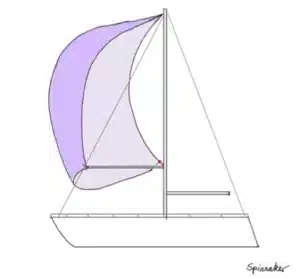
Large, balloon-shaped headsail of a yacht, which is fixed to the mast with a spinnaker pole. It is cut symmetrically and has two equal halves vertically.
-
Spitz sailing
-
Sail upwind at an angle of around 40° to 45°.
-
Sprayhood
-
A canopy made of plastic fabric and sailcloth that protects against splashing water and wind.
-
Spring
-
A line that is used in addition to the fore and aft line to moor a ship. If the spring is attached to the foreship, it is called a fore spring
-
Stag
-
A metal cable that gives the mast stability to the front and rear.
-
Stamping
-
Moving the yacht around the transverse axis, i.e. rocking forwards and backwards.
-
Starboard
-
The right-hand side of a boat. In the past, the rudder was attached to the right-hand side of a boat.
Back = opposite, i.e. port side. -
Steering position
-
The helm station, often referred to as the bridge, is the area on a ship from which the navigation and control of the ship takes place. It typically contains the rudder, navigation equipment and other control elements that are necessary to steer the ship safely.
-
Stems
-
The foremost part of the bow, where the sides meet.
-
Storm sailing
-
Sailing in strong winds and waves.
-
Stretch bend
-

When crossing, the side on which you are closer to the target.
-
Strong wind
-
Strong wind with wind force 6 on the Beaufort scale.
-
Sun protection
-
Measures to protect yourself from the sun when sailing.
-
Surface vessel
-
The part of the hull above the water. The opposite of this is the underwater hull.
-
Surplus
-
The parts of the bow or stern of a boat hull that protrude freely forwards or aft above the waterline.
-
Swell
-
The swell of a passing ship or a swell, in this case long, even waves running into a harbor.
-
Sword
-
No, not for fighting, but a movable plate, usually made of plastic on a modern sailing yacht, which is designed to prevent drifting under the hull. Depending on the wind course, it is lowered more or less into the water.
-
Swordboat
-
Smaller, dimensionally stable, capsizable but unsinkable sailing boat. Instead of a fixed ballast keel, they have a retractable centerboard. Centerboard boats are also called dinghies.
-
Tack
-
A course change in which the boat takes the wind from one side to the other.
-
Talje
-
A pulley block to control large loads, such as large sails, e.g. the mainsail or the blister
-
Top-heavy
-
A yacht is top-heavy if it dips further forward than aft.
-
Trimming
-
Prepare the boat so that it runs optimally, i.e. is in a balanced floating position. There are different trim options that affect the boat in different ways. One option is to ride out.
-
Turnaround
-
When tacking, the front part of the boat, the bow, is turned through the wind and the sails change sides.
The tack is started with the command "Ready to tack" and the yacht turns through the wind with the command "Rhe". -
Unclean ground
-
Poor anchorage ground, e.g. due to various obstacles lying around such as wreckage, chains or stones.
-
Uncorkable
-
A boat is unsinkable if it still has a righting moment even after a 90° heel. This is due to the low center of gravity of keelboats. The yachts we sail with are keelboats and therefore cannot be capsized.
-
Undercutting
-
Put the front part of the yacht into the water so that the speed is slowed down.
-
Unsinkable
-
Mostly small boats that contain certain buoyancy bodies and therefore cannot sink. Dinghies, for example, can capsize, but they are unsinkable.
-
Want
-
The bracing of the mast to the sides to give it more stability. For larger boats such as yachts, a distinction is made between upper and lower shrouds.
-
Weathering
-
If there is a storm on the open sea, do not continue sailing and just be careful not to get into distress.
-
Webelinstek
-
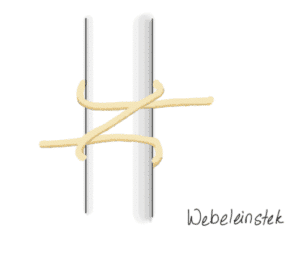
Weaving rope for attaching fenders to a railing, bollard or post. The weaving rope can be inserted, laid or thrown.

Expand your sailing knowledge on one of our SKS training cruises in our Croatian and Majorcan waters
-
Winch
-
The winch helps to pull the sail. A line is laid three times around the winch and cranked with a winch handle. The numerous gears that mesh together make it easier to pull the line.
-
Wind direction
-
The direction from which the wind blows.
-
Wind force
-
Unit for wind speed. In 1806, the English admiral Sir Francis Beaufort created the wind forces 0 to 12 on the Beaufort scale, which describes the wind force and its effects at sea. Today, wind force is measured at a height of ten meters for exactly ten minutes and then determined. Short gusts do not increase the wind force according to Beaufort.
-
Wind sea
-
The swell fanned by the wind. The natural deceleration of wind on the surface of the water creates friction, which is transferred to the water as energy. This creates waves, which are characterized by sharp wave crests in windy seas.
-
Wind shears
-
A change in wind direction or strength within a short distance.
-
Windward
-
The side of the sail facing the wind. If the wind is coming from port, windward is on the port side of a boat. Opposite windward is leeward.
-
Windward sheet
-
The windward-facing (windward), currently unused fore sheet. In other words, the line facing the wind on which the sail is eased or tightened.
-
Yacht
-
A large sailing boat.
-
hawser
-
Strong rope with a diameter of just over 4 cm, which is used for towing large ships, for example.
-
staysail
-

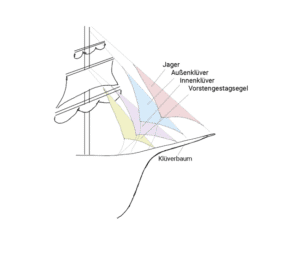
Sail that is used on a stay, usually with a loose foot. Classic cutters have 3 staysails: jib, jib, flyer. Tall ships have 4 staysails: fore staysail, inner jib, outer jib and jagger.